


Minister Timilsina calls for quality improvement alongside expansion of telecom services
Kathmandu: Minister for Information and Communication Dr Bikram Timilsina has directed concerned agencies to prioritise improving the quality of telecommunication services while expanding their reach across the country.
During a discussion with officials from the Nepal Telecommunications Authority and Nepal Telecom at the Ministry today, Minister Timilsina said citizens have been continuously complaining about poor telephone and internet services. He urged both the regulatory authority and service providers to work seriously and in a result-oriented manner to address the complaints.
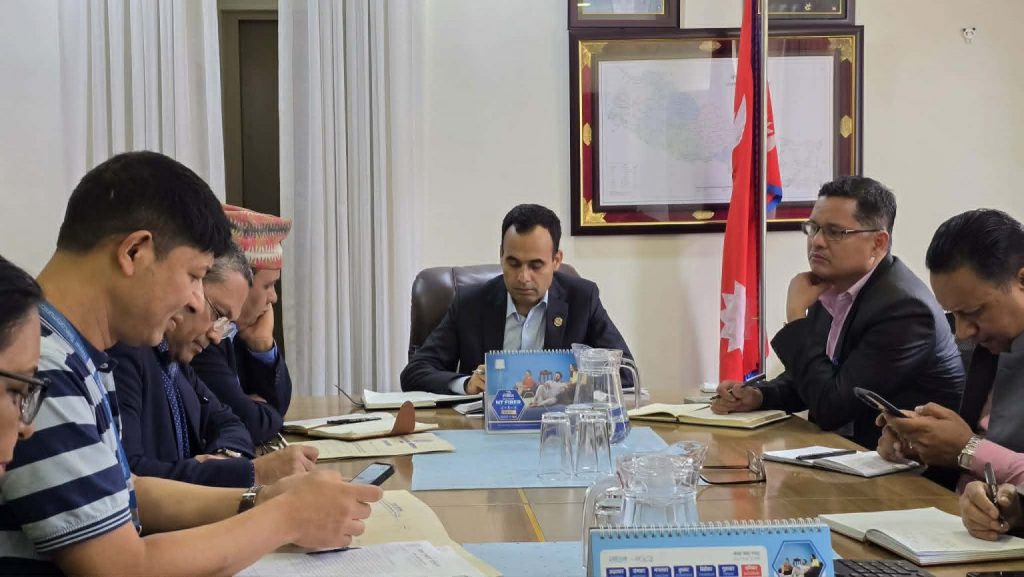
Minister Timilsina said the government has declared the current fiscal year as the “year of transformation” for the telecommunications sector, and that tangible results of the government’s initiatives should now be visible to citizens.
He expressed concern that people in remote areas, as well as some urban locations, are still deprived of reliable telephone and internet services, while funds collected under the Rural Telecommunication Development Fund (RTDF) have not been utilised effectively.
“RTDF funds are citizens’ money, and citizens should benefit from them,” Minister Timilsina said. He directed the Nepal Telecommunications Authority to ensure effective regulation and monitoring of the use of the fund, while service providers should ensure quality services.
The Minister said service providers could expand infrastructure through their own investment in urban and commercially viable areas. However, the state must play a greater role in remote areas where commercial returns are low.
He stressed that providing basic communication services to citizens in remote areas should be prioritised over immediate commercial profit. Even where the construction of a mobile tower does not generate immediate financial returns, connecting citizens to communication services should remain a priority of the state, he said.
Minister Timilsina also directed Nepal Telecom to move ahead with a clear business plan for service expansion and quality improvement. He called for the acceleration of projects that have remained incomplete or have yet to become operational, particularly those related to optical-fiber expansion.
He instructed the concerned agencies to immediately review and finalise stalled projects involving tower construction and optical-fiber expansion and prepare a detailed action plan within a week on how to move them forward.
The Minister also directed government agencies to strengthen coordination during the expansion of telecommunication infrastructure. He called for necessary coordination with the Department of Roads, Nepal Electricity Authority and other concerned agencies to prevent delays and ensure faster results.
During the discussion, Nepal Telecommunications Authority Chairman Arjun Ghimire said the authority had been working for years to expand telecommunication services through RTDF funding, but some projects remained incomplete.
According to Ghimire, optical-fiber expansion projects launched in Koshi, Bagmati and Madhesh provinces using RTDF funds have not been completed on schedule. As a result, payments related to the projects have also remained pending.
He said telecommunication service expansion projects had also been initiated through the RTDF in Sudurpaschim and Lumbini provinces. The authority would coordinate the mobilisation of RTDF funds for service expansion in remote and geographically challenging areas, he added.
Ghimire acknowledged that citizens’ complaints had not been addressed as expected despite the availability of financial resources, technology and human resources for expanding telecommunication services. He reiterated that state investment is necessary in remote areas where commercial returns are limited.
Nepal Telecom Managing Director Sangita Pahadi said expanding telecommunication services in remote areas with low investment returns remains challenging. She said additional frequencies, bandwidth and infrastructure are required to expand telephone and internet services in such areas.
Pahadi said operating services in remote areas using satellite bandwidth would be costly, while the commercial returns would be limited. She therefore proposed mobilising RTDF funds to cover such expenses.
Nepal Telecom said some remote areas currently have access only to 2G services, while additional investment is required to expand 4G services. The cost of bandwidth is also significantly higher for 4G services compared to 2G, requiring additional resources to provide high-speed mobile internet in remote areas.
Nepal Telecom has set a target of expanding optical fiber by around 1,000 kilometers during the current fiscal year. The company, however, said it intends to make further progress rather than limit its work to the annual target.
The telecom company has also requested that necessary support for optical-fiber expansion be provided through the RTDF.
The meeting also discussed the problem of unorganised wires used for telecommunication and internet services in urban areas. It was agreed that the concerned agencies would strengthen coordination to remove, organise and, wherever possible, underground wires currently laid haphazardly along roads and public structures.



Comments