


Proposed Chief Election Commissioner presents his action plan in parliamentary hearing
Kathmandu: Proposed Chief Election Commissioner Man Bahadur Karki has presented his plan to devise legal provisions regarding the cancellation of the registration of political parties that do not take part in the elections.
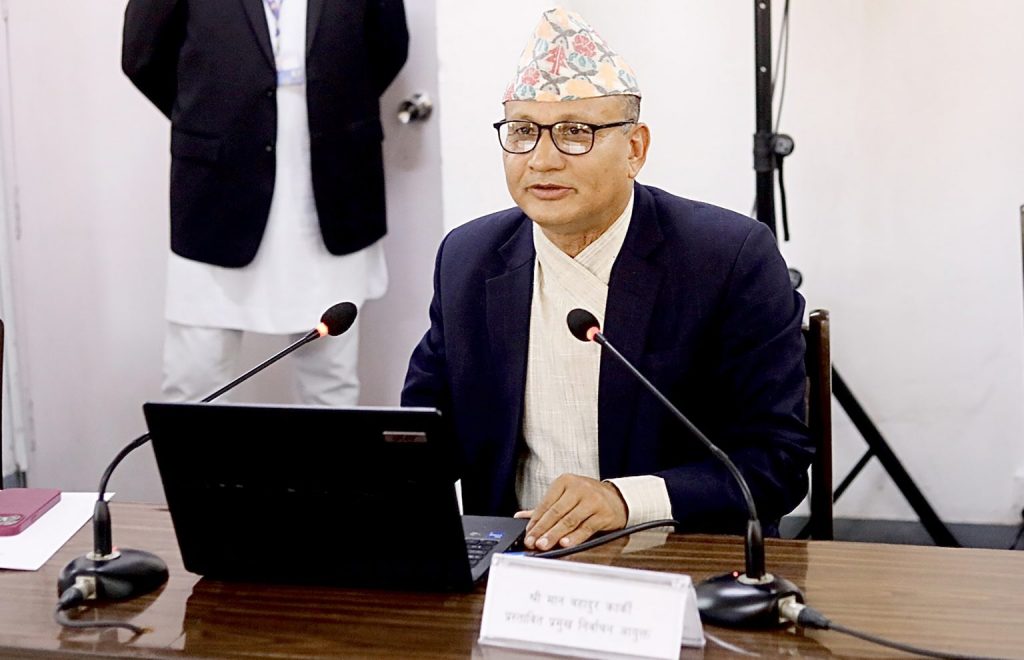
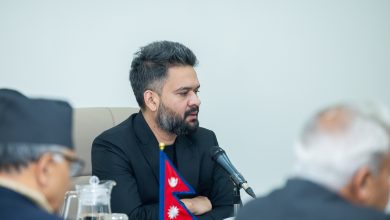
Karki presented his work plan in today’s meeting of the Federal Parliament’s hearing committee, and suggested that parties not participating in the elections could be encouraged to unite with each other.
The proposed Chief Election Commissioner said, “It is necessary to strengthen internal democracy within political parties, implement proportional and inclusive representation, and strengthen institutional dialogue between the Election Commission and political parties.”
He suggested that legal provisions could be made regarding the idea of ‘no vote’ for any candidate, and expressed the view that voter education needs to be effective to reduce invalid votes.
The proposed chief election commissioner Karki suggested that in relation to elections, a secure data centre could be created by linking interconnectivity among the three levels to prevent duplication of the voter list. On the occasion, he vowed to make Nepal’s election system more up-to-date, tech-friendly, cost-effective, and reliable by giving Nepali citizens abroad the right to vote, and to prioritise creating inter-district voting and a unified election law.
Proposed chief commissioner Karki mentioned that in the changing democratic environment, making elections more clean, independent, fair, and credible is the current major challenge, and he has provided an action plan focused on contemporary issues related to election reforms.
A proposal has been made to put in place the necessary legal and technical arrangements to ensure the voting rights of Nepali citizens living abroad and voters residing outside their electoral district, according to the plan.
He has highlighted making elections cheaper and more manageable, making the financial dealings of political parties transparent, and increasing public trust in elections as his main reform agenda. The action plan emphasises using information technology to the fullest for a clean voter list, broad voter participation, and effective enforcement of the code of conduct.
The proposal includes plans to make all services of the Election Commission tech-friendly, have online voter registration, use biometric identification, GIS and GPS technology, establish modern data centres, and expand digital systems in election management.
The plan also includes making it mandatory for political parties and candidates to handle their financial transactions through the banking system to control election expenses, having regular audits of election spending, and reviewing the limits on campaign expenses.
According to the action plan, a system will be developed to automatically update such voter lists by linking them with the national ID and civil registration system so that details like birth, death, and migration are updated automatically.
The plan also presents a programme to run voter education aimed at increasing voter turnout and reducing invalid votes by institutionalising voter education right from the school level. The plan mentions that to ensure the voting rights of Nepali citizens abroad, eligible voters will be identified, diplomatic coordination with the relevant countries will be established, and the appropriate method of voting will be chosen.
The Proposed Chief Commissioner Karki stated that postal voting and voting through the internet could also be arranged in the context of Nepal after conducting a study of the ballot boxes, postal voting, internet, and representative voting systems.
The committee members had asked Karki questions based on his work plan and current election issues. Earlier today, the committee held a discussion in the committee with the complainants against Karki.
The Constitutional Council, in its meeting on July 3, had proposed Karki as the Chief Election Commissioner and Guru Prasad Wagle and Dr Rajiv Subba as commissioners, and sent their names for parliamentary hearing.
RSS

Comments