


Legal liability issue is major hurdle to climate compensation for loss and damage: Climate Expert Uprety
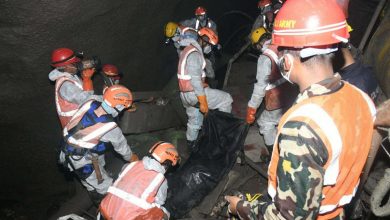
Kathmandu: As Nepal steps up its call for greater international support over climate-induced loss and damage following the devastating Bhotekoshi flash flood, questions are being raised about the country’s climate policy, preparedness and international advocacy.
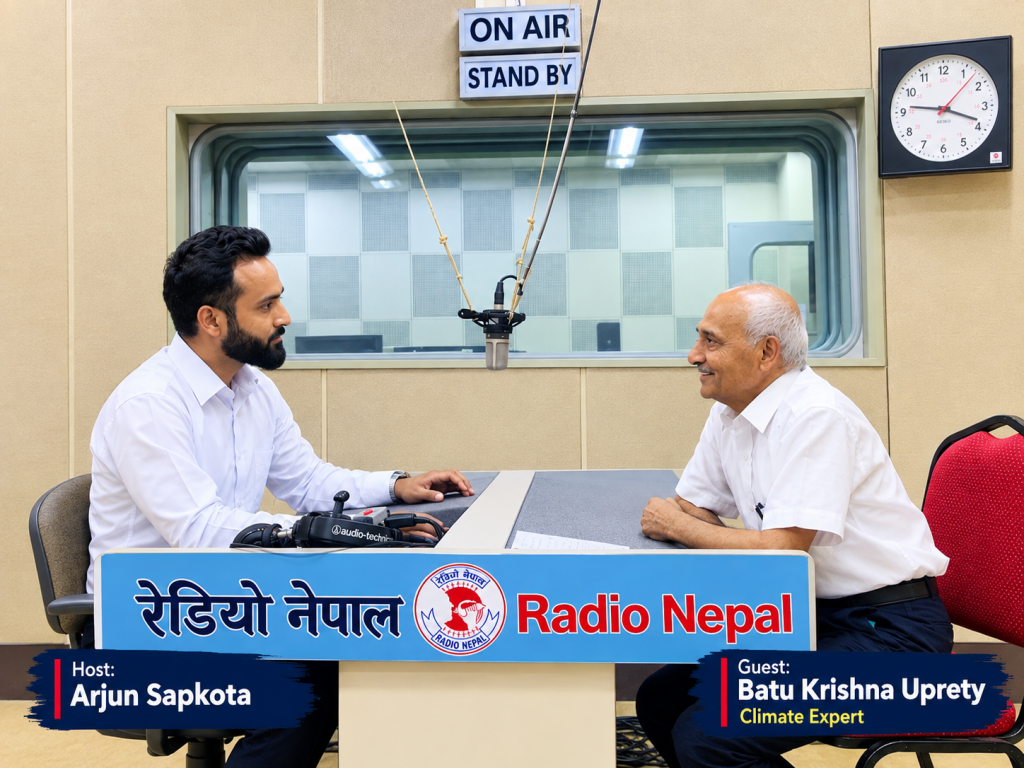
In this context, Radio Nepal’s English News Editor Arjun Sapkota talks with climate change expert Batu Krishna Uprety, a veteran environmentalist who served the Government of Nepal for nearly three decades and was the first head of the Climate Change Management Division under the Ministry of Environment.
Uprety was closely involved in developing key climate policy frameworks, including Nepal’s National Adaptation Programme of Action and Local Adaptation Plans for Action, and has extensive experience in international climate negotiations.
In the conversation, Sapkota and Uprety discuss Nepal’s call for climate justice and its climate advocacy over the years, the lessons from the Bhotekoshi flash flood, and what Nepal should now seek from the international community, including at the ongoing 81st session of the United Nations General Assembly in New York, in terms of climate justice and support for loss and damage.
To begin with, how should we understand the recent flash flood in Rasuwa and surrounding districts from a climate change perspective? Was this an isolated mountain hazard, or does it reflect a wider trend of increasing climate-related risk in Nepal?
I do consider that there might be several factors. One of them is the collapse and rock avalanche, and one of the major factors is climate change due to rising temperatures.
But still, we need scientific evidence to convince the international community. The scientific community is somewhat clear that it is linked to and triggered by climate change. There is no problem with that.
Still, there might be other factors as well. Hence, I consider that climate attribution should be considered during further assessment of the area to inform and convince the international community, particularly decision-makers and policymakers.
Are there enough research and investigations in Nepal to understand such disasters, given that the country may experience similar events in the future?
I think research is very weak. Research and studies at high altitudes, above 3,000 metres, are very limited. There are very few meteorological stations.
In my understanding, and based on the definition of the World Meteorological Organization, we need around 30 years of data on temperature to confirm changes in the climate system, particularly temperature changes.
As we do not have hydrometric stations at higher altitudes, it is difficult to directly link all events with climate change. For that, we need further assessments and studies from a scientific perspective.
Nepal contributes very little to global greenhouse gas emissions. Yet, it remains highly vulnerable to climate-related disasters, as demonstrated by the recent flash flood. The scale of the disaster has attracted international attention, including support from leaders and governments of developed countries. However, Nepal has been saying that it does not need sympathy alone. It needs climate justice. From your perspective and experience, what does Nepal mean by climate justice in this context?
A very pertinent question. It was previously linked with compensation as well.
Nepal was one of the first countries in the region to introduce climate justice in its climate change policy. If you look at the 2011 Climate Change Policy, we introduced climate justice. Our understanding of climate justice at that time was based on the UN Framework Convention on Climate Change.
Developed countries have a responsibility to support developing countries because of their historical responsibility for greenhouse gas emissions. In that context, they need to support developing countries with finance, technology, capacity building and, basically, the means of implementation for climate action. That was our understanding, and developed countries should provide such support.
But when it is linked with compensation, my understanding is that compensation is linked with the legal aspect. The issue of legal liability is not easy.
We know which country has emitted how much greenhouse gas, but we don’t know in which country’s snow-melting process the impacts have increased. So, there should be some sort of international mechanism to support and provide finance, technology, capacity building and other kinds of support to developing countries, particularly climate-vulnerable countries like Nepal.
That is not legal liability, but it should be a major part of climate justice.
So, my understanding of climate justice and compensation is different.
To link with your answer, the International Loss and Damage Fund has been established to support countries most vulnerable to climate change, like Nepal. Is the fund sufficient to meet Nepal’s growing needs, and how can Nepal access these resources?
Let’s first understand that there are five funds under the climate change regime.
They are under the Kyoto Protocol, the Climate Change Convention and the Paris Agreement. There is the LDC Fund, a dedicated fund for the 45 least developed countries. There is also a Special Climate Change Fund for developing countries.
There is an Adaptation Fund, which is only for adaptation, where two percent of carbon trading automatically goes to the Adaptation Fund. And then there is also the Green Climate Fund. After these four funds, the Fund for Responding to Loss and Damage was agreed upon.
And please note, these are all pledge-based. Developed countries pledge how much they want to support. Last year, there was a commitment of around 800 million dollars.
Now there is about 450 million dollars or something like that. So, the important thing is that we have to understand that it is pledge-based. Besides this, there are multilateral funds and bilateral funding as well.
So, there are several windows. One of the windows is the Fund for Responding to Loss and Damage. But one thing is important to understand: there is no provision for compensation in the Convention. We don’t get any support through a compensation process.
We get support from international financing mechanisms, which provide some sort of financial assistance. So, we should not use compensation because, again, in my understanding, compensation means legal liability. Compensation is not possible.
Just to come to your point, Nepal has sent a letter to the Fund asking for compensation regarding the devastating flash flood. How easy is it to get the fund addressed?
Yes, that is a very important question. For the FRLD, Nepal is also an alternate member of the FRLD Board, that is, the Fund for Responding to Loss and Damage.
There are altogether 26 members and 26 alternate members. There will be one co-chair from the developing countries and one from the developed countries. There will be two co-chairs.
Nepal has sent the official letter signed by two ministers. And I also have some reservations about whether it should have been signed by the ministers or whether it should have been sent through the focal point. That is another issue.
And let’s say Nepal has sent it. Nepal will not get compensation. What Nepal will get is through the Barbados Implementation Modality. The Board approved the implementation modality in Barbados.
Based on that modality, Nepal will receive some funding. The upper limit of the fund is 20 million dollars. It ranges from five million to 20 million dollars.
Nepal has submitted three projects. One is almost 20 million dollars. I expect, based on the news, that Nepal will secure 20 million dollars.
Again, whether we have to wait until mid-December for the Board meeting or before that, what has been said is that the Board has technically reviewed Nepal’s proposal and sent it to the Nepali delivery partner, the AEPC, I think. They have to address the review comments. Once the AEPC clarifies the review comments, the Board will decide.
My understanding is that the Board should decide on that because there are 26 members, 14 from developing countries, including LDCs and small island developing states, and 12 from developed countries.
So, the majority of the countries must agree on the proposal?
Yes, 14 countries will agree. Let’s hope they will agree. There is no provision that the majority cannot approve it.
In the UN system, they prefer consensus. If that does not exist, there should be a four-fifths majority, that is, 80 percent of the members should vote if there is any condition for voting.
But what I think is that Nepal will get 20 million dollars.
Nepal will receive it before December or after the Board meeting in mid-December. Still, I consider that the Board meeting should decide on it based on the Board’s mandate.
But there is also a possibility. I don’t consider that it can be done, but the co-chairs might facilitate it and respond to what Nepal has requested.
They have to respond as a matter of emergency. If it has been considered some sort of emergency by the FRLD, that might be one school of thought.
But when we are pushing it as part of compensation, compensation is linked, again in my understanding, with legal liability.
Nobody wants to establish a precedent on legal liability. That is the crux of the problem. We have been advocating this since 2011.
International insurance was raised in 1991. It did not materialise in the Convention.
There is no provision. The loss and damage concept was introduced in 2007 in Bali, under enhanced action for adaptation. That was coined there.
Then, in 2010, there was some progress in Cancun, Mexico, and in 2013, the Warsaw International Mechanism was developed. Then, in Warsaw, loss and damage was introduced in the Paris Agreement. Again, the Paris Agreement does not mention compensation.
It is very important that, as I said earlier, the Convention, the Kyoto Protocol, the Paris Agreement or any other regime that deals with climate change does not even use the word compensation.
If there is no word such as compensation in the constitution, how can we develop legislation based on compensation? That is the major issue.
How seriously do you think the international community is taking Nepal’s concerns and its demand for greater support for climate-induced loss and damage and even compensation?
For compensation, I don’t think they will agree.
I attended 11 COPs. There are people who attended 16 or 17 COPs in Nepal as well, continuously. Based on my experience, they hesitate.
First, they hesitate to discuss loss and damage. They try to block it. And when the issue of compensation comes, it is all bracketed.
It means there is no decision. That is the major reason why, in loss and damage-related negotiations and decisions, there is no call for compensation.
They link it with legal liability. Everybody, I also link it with legal liability. The better person, or the competent professional, would be a legal specialist who can interpret it.
But still, I think compensation is linked with legal liability.
The 81st General Assembly of the United Nations has begun . Nepal is going to raise the issue of loss and damage and climate justice in the UN General Assembly. From your experience, what specific demands should Nepal put on the international forum rather than making only a general appeal for climate justice?
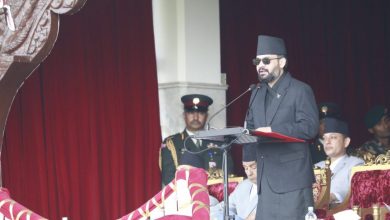
When our Prime Minister attends and makes a statement at the General Assembly, that is some sort of political message that Nepal wants to give to the international community.
After the political message, if the UN makes a resolution, a specific resolution on the issue, that will have broader meaning.
If not, about the impacts of climate change in the mountains, the snow-melting process, or the formation of new glaciers and glacier lakes, these issues have been raised from the early stages of the Conference of the Parties to the Framework Convention on Climate Change.
So, one thing is giving the political message and drawing the attention of the international community. The other thing is making some decisions.
I can cite simply one example. The Minister for Agriculture, Forest and Environment attended the LDC ministerial meeting in Dili, Timor-Leste, on 3rd September. Nepal raised this issue, the Bhotekoshi issue.
That is fine, excellent. The Delhi Declaration clearly mentions sympathy and notes the rock avalanche in Bhotekoshi. That is fine, excellent.
Forty-four LDCs acknowledged it. But I wanted to see whether the LDC or the Delhi Declaration had mentioned or called on the international community to immediately support Nepal’s request, because Nepal has already requested the FRLD. I didn’t see that type of call in the Delhi Declaration.
That meeting was attended by our minister and other ministers of the LDCs, the least developed countries. It is good that our Prime Minister will make this case, present it and inform the international community about the need for support.
Again, I don’t encourage the use of the word compensation.
We can use climate justice. It is vague and covers many things. Based on that, we will have the opportunity to interpret and reinterpret the concept of climate justice.
Based on that, there is a greater possibility of getting international support, because developed countries have also realised it. They are also finding ways to support Nepal following this unimaginable disaster.
Again, the important thing is that it is linked with legal liability issue.
You mean to say that developed countries must take a lead in materialising the concept of climate justice and providing climate justice to vulnerable countries like Nepal?
Again, the thing is that there should be joint action. Joint action, in my understanding, means that developed countries should understand and recognise what our mountains are and how they are formed, and again how the processes are ongoing in the mountains because of climate change.
They should hear our voice. We should also hear their limitations.
Despite Nepal experiencing this scale of damage, particularly this time, world leaders including Donald Trump, the British Prime Minister, the Australian Prime Minister and activists noticed and pointed out the disaster in Nepal, and the particular event has now gained international attention. So, is this going to help Nepal advocate the point it has been raising for climate justice?
The president of the Rastriya Swatantra Party (RSP) in Parliament has made a clear statement on climate justice. There is some scope for parliamentary committees or parliamentarians to inform and give instructions to their government to support Nepal.
But when you talk about America, America, I think, may not want to link it to climate change impacts because it has already withdrawn twice from the Paris Agreement.
So, their support might be on humanitarian grounds or infrastructure development. That is my guess because they are not a party to the Paris Agreement.
In the case of Australia, its economy is also fossil-fuel based. Let’s say other developed countries, including the United Kingdom, may support Nepal for climate justice, taking broader aspects of climate justice. But again, we insist on compensation.
I have seen a very difficult situation on this. That is my understanding of compensation, but we should move through climate justice.
Mr. Uprety, you were involved when Nepal was building the foundations of its climate change policy and taking its vulnerability to the international community. More than a decade later, we have witnessed devastating floods in Nepal. Looking back, what did Nepal get right in its climate advocacy? What did it fail to achieve, and what must it demand differently from the world now?
In my understanding, we started developing some instruments that helped us seek international support. For example, we first prepared NAPA, the National Adaptation Programme of Action, which prioritised the most urgent and immediate adaptation activities that Nepal needed to develop its capacity to address climate change from an adaptation perspective.
We have a very negligible share—around 0.058, or close to 0.06 percent—of total greenhouse gas emissions, according to the Third National Communication published by the government in 2021.
We developed NAPA, and then we prepared the framework for how to localise adaptation. Nepal was the first country that wanted to localise adaptation by preparing a national framework for Local Adaptation Plans for Action.
Nepal was the first country, and we started implementing adaptation activities through the LAPA process. There is a process for how we should implement this.
Then, we prepared the Climate Change Policy in 2011, and at that time we introduced the concept of climate justice with a broader understanding of how to obtain international support.
Again, this was not about the legal responsibility of developed countries because there is a problem with that. You can see that our Environment Protection Act has a provision for compensation. But how difficult is it to charge a country or a person for such atmospheric gases? That is my concern.
Later on, the government fulfilled almost all of these requirements. We now have the Nationally Determined Contribution, as well as a climate change policy following the new government structure and the new Constitution in 2015.
So, we have the policies, strategies and other instruments that can support the implementation of climate action.
There is no problem with that. The problem is translating our national instruments into action. For this, we need capacity, technology and, most importantly, finance.
How much finance have we received for this? And, most importantly, for climate support, there is an issue of additionality, which we call climate attribution in the case of Bhotekoshi flood. That is very important. We have to establish that it is related to climate change.
We have to provide evidence. That evidence should convince the international community. We can convince the scientific community, but there are also the administrative and diplomatic communities. So, there is a process for that.
In that case, on the policy side, in terms of action plans and the NDC, we have complied with what is required.
But our main difficulty is implementation. How can we implement these policies? How can we strengthen our local institutions? How can we internalise climate and environmental issues through the national system?
We have them on paper. But during the planning or implementation process, how can we internalise them? This is particularly important in areas affected by Bhotekoshi food and during reconstruction.
Let’s look at this from a third angle. How can we make our future infrastructure climate-resilient and environmentally friendly? That is most important. So, our sectoral approach to development needs to be opened up and widened.
Finally, Nepal is highly vulnerable to climate-related disasters and events like the Bhotekoshi flash flood. From your experience in this field, how prepared is Nepal to cope with disasters of such a large scale? And what key lessons should Nepal learn to better prepare for and manage similar disasters in the future?
The important thing is that we have established an early warning system. But in the Bhotekoshi case, it did not work.
This is unimaginable. Even scientists had not considered such a possibility. And when we see some newspaper reports, even those who had been working in the tunnel for several years had not thought along these lines.
This has provided us with some important lessons. The important thing is that we have to generate data. We must have data.
Now, we have the Department of Hydrology and Meteorology, and that institution should be strengthened. We must have meteorological stations and hydrological stations, even at high altitudes, because what happens at high altitudes will affect people living downstream.
It is a clear example from Bhotekoshi, Thame, Melamchi and other disasters we have faced in the past. So, to convince others and generate evidence, we need hydrometeorological data. For that, again, we have to strengthen our capacity for data generation and research.
We have been advocating for the last several years, perhaps around two decades, for some sort of climate change resource centre that focuses on generating evidence and analysing available data. Based on government requirements, we need to determine what type of evidence we need to generate to inform and influence the international community and show that an event is linked to climate change, for which we are not responsible based on greenhouse gas emissions.
If we have some sort of well-equipped research institute, we can strengthen the existing ones. We can establish a specific wing for climate research within an existing research institution, or we can establish a research centre.
That is what we foresaw in 2009, and it was included in the 2011 policy. It is also included in the 2019 Climate Change Policy, but we have not been able to expand it.
We can also ask ICIMOD, the International Centre for Integrated Mountain Development, to conduct specific research for Nepal and Tibet on the GLOF issue or on these new types of events.
We have been thinking about glacial lake outburst floods, but here we have a rock avalanche and a collapse.
So, let’s look at the geological issues and geodynamics—how the mountains are functioning and how stable or movable they are. We need a team of good experts from Nepal and abroad or Nepalis working abroad, whose resources and expertise we can tap into and continue this work.
It is high time. We cannot wait until after a disaster. We simply learn the lessons, but our experience is that we forget them tomorrow.
We have already forgotten Thame and Melamchi incidents, and we will forget this one after the rescue operation is over. That is the main problem for us.
Let’s hope that the new government might take new initiatives on this, because this event has broadened the understanding of politicians, executives, the climate community and others.
Below is the full audio conversation with climate expert Uprety.
Comments