


Foreign Minister Khanal urges production- and technology-driven economic ties between Nepal and India
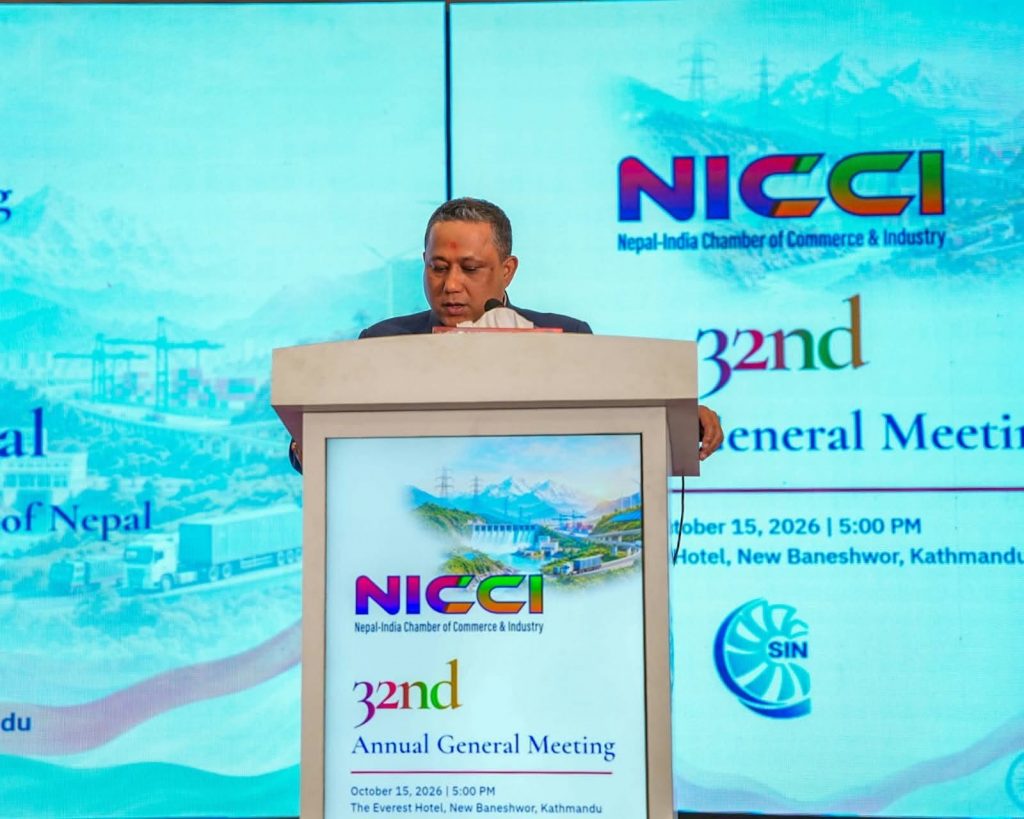
October 16, Kathmandu: Minister for Foreign Affairs Shisir Khanal has emphasised that bilateral economic cooperation between Nepal and India must transition toward production-driven, diversified, and sustainable frameworks across trade, energy, digital technology, and tourism.
Addressing the 32nd Annual General Meeting of the Nepal-India Chamber of Commerce and Industry in Kathmandu on Thursday, Minister Khanal stressed the necessity of translating traditional diplomatic ties into concrete economic achievements.
“Diplomacy is no longer limited to the Ministry of Foreign Affairs, formal talks, and treaties. Industry, trade, energy, and digital payment systems have also become vital areas of economic diplomacy,” Khanal stated. Noting that India remains Nepal’s largest trading partner and primary source of foreign direct investment, he pointed out that India accounts for over 60 percent of Nepal’s total external merchandise trade and more than 80 percent of its total exports.
Calling upon Indian investors to expand their footprint in Nepal, Khanal highlighted the need to build domestic production capacity, generate employment, attract quality investments, and diversify exports to integrate Nepali enterprises into regional value chains. He outlined key priority areas for bilateral cooperation, including trade facilitation, industrial partnerships, cross-border energy integration by connecting Nepal’s hydropower potential with India’s expanded energy market, and technological collaboration in digital payments, artificial intelligence, and financial tech.
Positioning the private sector as a critical partner in economic diplomacy, Khanal urged the Nepal-India Chamber of Commerce and Industry to help identify trade barriers, promote joint ventures, and streamline border infrastructure, transport costs, and regulatory frameworks to foster a predictable business environment for small and medium enterprises, women entrepreneurs, and young business leaders.






Comments