


OPMCM unveils its major deliveries
Kathmandu, Oct 2: The Office of the Prime Minister and Council of Ministers (OPMCM) has unveiled details featuring its major accomplishments from mid-August to October 2.
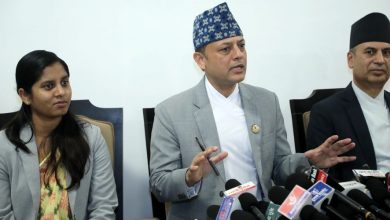
OPMCM spokesperson and joint secretary Hemraj Aryal shared the details during a regular press briefing at Singha Durbar on Friday.
The press briefing resumed following its halt for some time due to the floods in the Bhotekoshi-Trishuli river systems.
As per the details, Prime Minister Balendra Shaha attended the 81st session of the United Nations (UN) General Assembly from September 22-26, addressing the Session on September 25.
His address specifically highlighted the Bhotekoshi-Trishuli floods and the loss and damage caused by the disasters, linking the catastrophe to the climate crisis.
The secretary-level meeting held on September 21 decided to take measures for regularising the traffic in view of the upcoming Dashain, Tihar and Chhath festivals and the monsoon, and to intensify joint market monitoring to prevent possible supplies of goods on the black market and artificial price hikes.
Discussions were held with the participation of federal ministries and bodies regarding the progress review of the annual action plan for the fiscal year 2082/83 BS and the detailed implementation plan for the fiscal year 2083/84.
Similarly, performance agreements were signed on September 3 with secretaries and heads of the divisions by prioritizing good governance, service delivery, development management, and programmes capable of yielding tangible benefits for citizens.
Similarly, assessment of post-disaster needs is underway under the leadership of the National Planning Commission following the identification of loss and damage from the August 26 flood disaster. A total of 25 government officials participated in a training conducted on September 21- 25, aiming to increase the use of data and evidence in policy analyses.
“The Government Decision-Making Process (Simplification and Digitalisation) Regulations, 2083 BS were published in the Nepal Gazette on September 28. The Regulations aim to make the government decision-making process simplified, transparent, digital, paperless, time-bound, and citizen-centric.
Activities during this time included a meeting of the federal coordination committee for the implementation of the Sixth National Action Plan on Human Rights; three trainings on public procurement for 83 employees at government offices; preparation of necessary rates and standards for the procurement of IT systems in the final stage; continuation of ‘data mapping’ at various ministries for ‘data standardization’ of government bodies; publication of the report of the ‘Nepal Enterprise Architecture Framework’ for consultation; and settlement of 31,280 public complaints out of 77,128 complaints through the Hello Sarkar. RSS


Comments