


FM Khanal calls for stronger cooperation among climate-vulnerable nations
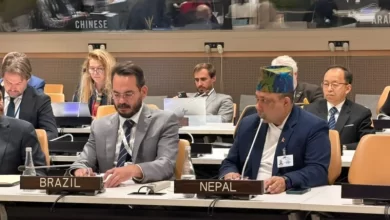
Kathmandu, Sept 24: Minister for Foreign Affairs Shisir Khanal has stated that stronger cooperation between mountainous nations and Small Island Developing States (SIDS) is essential to amplify the collective voice of countries vulnerable to climate change.
Addressing a meeting of the Climate Vulnerable Forum (CVF) in New York, on the margins of the 81st United Nations General Assembly, on Wednesday, Minister Khanal highlighted how the rapid melting of glaciers in the Himalayas contributes to rising sea levels via river systems, noting that both mountainous and island nations are facing similar impacts from the climate crisis.
“From glacial lake outburst floods in Himalayan valleys to powerful hurricanes in the Caribbean, frontline communities are paying the price with their lives, homes, and decades of development achievements for emissions they did not create,” he said.
Noting that climate change has posed serious challenges to the implementation of the 2030 Agenda for Sustainable Development, Minister Khanal stated that progress toward the Sustainable Development Goals (SDGs) has not moved at the expected pace globally, according to the Ministry of Foreign Affairs.
Although Nepal has made significant strides in sustainable development, climate-induced disasters frequently undermine the social and economic achievements the country has secured. Citing the example of the Bhote Koshi floods, Minister Khanal noted that a sudden disaster could inflict severe damage on vital highways, hydropower projects, schools, hospitals, and the livelihoods of local communities.
Highlighting Nepal’s commitment to nature-friendly economic development, its Nationally Determined Contributions (NDCs), and the goal of achieving net-zero carbon emissions by 2045, Minister Khanal emphasized the need to restructure the international development system to accelerate climate-resilient development, reform the development finance system, increase investment in forecast-based science and early warning systems, accelerate green and digital transformations, and make financial assistance for loss and damage effective.
He stated that Nepal welcomes the operationalization of a Lifeline Fund designed to provide rapid financial resources when climate-induced disasters create severe balance-of-payment pressures.
Minister Khanal stated that genuine restructuring of development systems requires shifting from risk-prone conditions to structural resilience, moving from ad-hoc humanitarian aid to predictable development finance, and transitioning from fragmented efforts toward deep collaboration between mountain and island nations.
“Nepal is committed to collaborating with all members of the forum to strengthen our collective voice and ensure a shared, secure future for generations to come,” he said.
Currently chaired by Prime Minister of Barbados, Mia Amor Mottley, the Climate Vulnerable Forum is an international partnership of countries highly vulnerable to a warming planet. Serving as a South-South intergovernmental cooperation platform, it is working to advance medium-term economic growth and development alongside long-term resilience and prosperity.
It currently comprises 74 member countries from Africa, Asia, the Caribbean, Latin America, the Middle East, and the Pacific, representing 1.7 billion people or 22.4 per cent of the global population.
Collectively, these nations contribute only 7.3 per cent of global emissions, yet they face some of the most severe climate impacts. RSS





Comments