


We pay a heavy price for a negligible mistake we made: PM Shah
Kathmandu: Prime Minister Balendra Shah has said that they have borne a huge brunt of the negligible mistakes they made. He asserted that the flood in the Bhotekoshi River in Rasuwa was its explicit result.
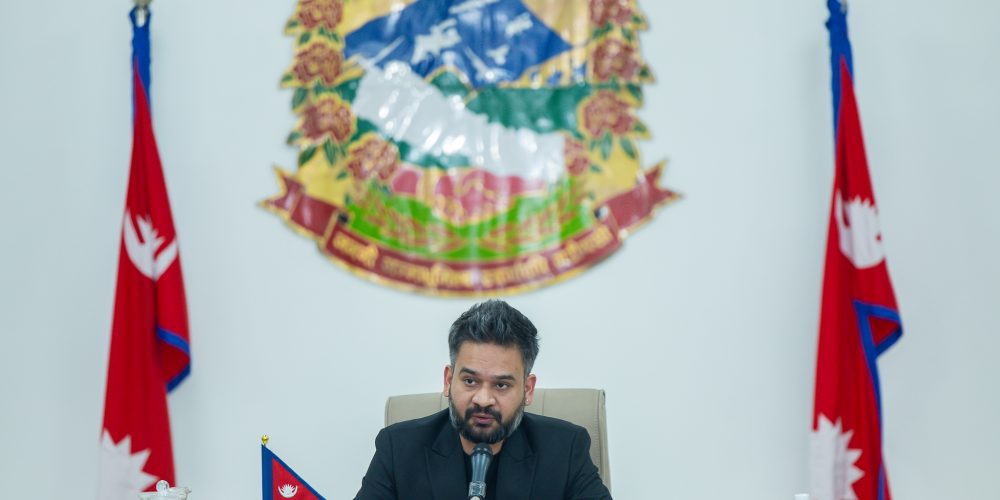
The disaster has left us with excruciating pain, he stated on his social media account today.
“We have been telling the world since a long time that climate change is having a big impact in the Himalayas, and the glaciers are melting. The effects are not just in the Himalayas but reaching up to the coasts. The fear we had for a long time has come true in the form of the devastating flood in the Bhotekoshi River in Rasuwa.”
Nepal has faced a tragic event, PM Shah said, adding, “We need to seek a response from the global community and provide an answer to humanity about this.”
Prime Minister Shah noted that managing natural disasters is a herculean task for everyone and that we are working round the clock by using available resources. He also said that Nepal is receiving international assistance during this disaster.
The Prime Minister mentioned that, in coordination with the province and local authorities, various holding centers have been operated in the affected areas to accommodate citizens. He said that food, clothing, and daily necessities are being provided for those affected. In Nuwakot, 2,796 citizens are staying in 24 holding centers.
“In Rasuwa, 195 people are accommodated in five holding centers, and in two locations in Kathmandu, we have set up holding centers to house 300 citizens from different affected areas of Rasuwa. Similarly, we are delivering relief by helicopter every day to 4,500 citizens from various areas of Rasuwa,” he said.
In coordination with the federal, provincial, and local authorities, we obtained information about the situation from the local staff and representatives in the affected districts as soon as the flood occurred, and based on the preliminary information provided by them, the disaster response has also been initiated, he shared.
The executive chief said the Office of Prime Minister and the Council of Ministers has also been in direct continuous coordination with them, and their grievances are also being redressed. “On the day of the catastrophic incident itself, a meeting of the Council of Ministers had declared the local level units of the affected districts as disaster-prone areas for three months according to Clause 32 of the Disaster Risk Reduction and Management Act, 2074,” he mentioned.
When we reached the flood-affected areas the day after the incident (August 27), we held a discussion with the Bagmati Province Chief Minister’s team about disaster management, the PM informed.
Afterward, the National Disaster Risk Reduction and Management Authority (NDRRMA) discussed with them and decided to take their responsibilities in disaster management more seriously, according to the Prime Minister. Infrastructure Restoration Prime Minister Shah mentioned that work is underway to restore infrastructure affected by the floods.
He stated that communication services have been restored more than 95 percent, but electricity is still pending for only 5.77 percent of households in the affected areas. Efforts to bring other infrastructure back to its original state are being carried out at a rapid pace under the leadership of the concerned ministries, he said. Infrastructure restoration is another form of relief for citizens affected by the disaster.
“Under the Galchi-Muglin road section, construction has been in progress on the hillside of Krishnabhir with a ‘gabion breast wall’ so that vehicles can operate over it. From today, work has started to cut trees and walls to open up the track,” he said. “For a long-term solution to Krishnabhir’s problems, necessary studies will be conducted on options such as tunnels, soil nailing, and sheet piles. By mid-September, we will operate traffic on this road section. A diversion has been constructed at Parewabhir, and traffic has already started there, while work to upgrade it is also ongoing.”
Out of 10 kilometers along the Trishuli-Betrawati road section, debris has been removed from eight kilometers, and work is ongoing on the remaining two kilometers. Emergency tenders have already been solicited to work on an additional 35 kilometers of damaged roads, he said.
According to him, foundation construction has started to place a Bailey bridge on Tadi. Efforts are underway to transport the Bailey bridge to Tadi by tomorrow.
At Betrawati, surveying has been done for placing a Bailey bridge, and foundation construction has begun. Surveying has started at Trishuli where a Bailey bridge with 120 meters breadth is deemed necessary.
RSS



Comments