


MoFA’s Summer Fellowship Programme: Government linking youths with foreign policy
Kathmandu: The ‘Foreign Ministry Summer Fellowship and Internship Programme-2026’ run with an objective of making Nepal’s foreign policy research based, timely and connecting young generation’s knowledge, skill and expertise concluded on Wednesday.
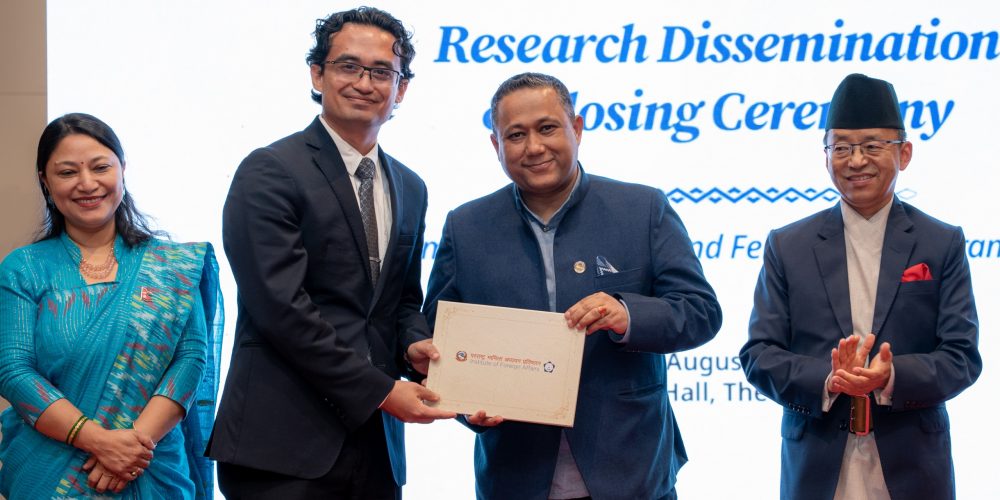
Opportunity was provided to Nepali young professionals, researchers and students at home and abroad to undertake research on key areas of Nepal’s foreign policy including strategic affairs, development and finance, emerging technologies, clean energy, and the Nepali diaspora in the eight-week programme orgaised by Institute of Foreign Affairs Nepal at the initiative of Foreign Ministry.
The programme brought together 10 fellows and 10 interns interested in policy and research sectors. Dr Hindu Sanskritika Karki, who carried out study and research on Nepal’s defense diplomacy in the programme, shared that the summer fellowship programme was an important opportunity for her.
She mentioned, “During the fellowship, we had opportunity to work closely with government and collaborated with other bodies. Furthermore, this has contributed significantly to enhancing our capabilities and it will also support the country in foreign affairs.”
Dr Karki holds a Ph.D. in International Politics from Fudan University, Sanghai in China. Initiative to connect youth’s knowledge and expertise in foreign policy Nepal’s foreign policy is based on long-term national interest.
The Foreign Ministry has been pointing out the need of making the quality and reach of Nepal’s diplomatic engagement further effective in changed international context. The role of research and new knowledge would be significant to forward economic diplomacy, investment promotion, trade expansion and enhancement of bilateral and multi-lateral relations linking with Nepal’s development, shared the Ministry.
Changes have been expected in the form of international trade, concessional financial access and development partners in coming days as Nepal is in the process of graduating from least developed country.
The Summer Fellowship and Internship Programme was forwarded as the initiative to connect knowledge of young researchers and professionals in policy-level at a time there is a need to make Nepal’s foreign policy and diplomatic mechanism further capable to manage such transition.
Foreign Minister Shisir Khanal mentioned that the programme was based on potential to harness the knowledge, skill, experience and international network of Nepali youths active in study and professional field in abroad for Nepal’s national interest.
The youths participated in the programme had got opportunity to closely understand the policy-related works being carried out in ministry’s priority areas. The summer fellowship and internship programme was developed based on mainly three basis—knowledge, partnership and network.
The Ministry expected that the participated youths in the programme could be used as advisor, reviewer or collaborator in future. Research in 10 topics As part of the programme, the participants had prepared their own research question, choosing one out of the 10 designated research topics. The ministry had defined the broad scope of the topic, and within that, participants set research questions based on their interests, expertise, and experience.
The designated main topics for research were strategic issues and public international law, digital governance and technology policy, emerging technologies and national security, conflict, instability and economic risks, and climate diplomacy and environmental issues.
Similarly, the topics of research also included energy transition and diplomacy, human mobility, labor diplomacy and workers’ rights, diaspora, inter-country communities and foreign policy, tourism, culture and public diplomacy, as well as development finance and investment diplomacy.
Apart from these topics, a provision was also made where the participants could submit open research proposals on other subjects that have an important connection with Nepal’s foreign policy.
The topics selected this way included emerging issues like technology, climate change, labor migration, energy, diaspora, public diplomacy, and development finance, alongside the traditional priorities of Nepal’s foreign policy.
Direct experience of ministry
The programme did not just prioritize research. There was also an arrangement to directly connect participants with the ministry’s operations and policy processes.
Participants joined weekly meetings with the ministry’s liaison officers to discuss the progress, challenges, and upcoming plans of their research.
Midweek, there was also a session where participants exchanged research findings with each other. Similarly, experts, practitioners, former diplomats, and regional specialists gave presentations on various topics related to foreign policy and Nepal’s international relations.
Through these sessions, participants got more insights into Nepal’s diplomatic practices and different aspects of international relations. The programme gave participants the chance to closely understand the ministry’s direct working methods, policy-making process, and diplomatic practices, rather than just limiting them to books and educational materials.
In the first week of the eight-week research programme, a formal orientation was held at the ministry. In the presence of senior officials, participants were introduced and the research topics and questions they would work on were formally registered. In the second week, each participant submitted a work plan that included their research questions, methods, sources, and expected results.
In the third week, the first structured guidance session was conducted with senior professionals. In the fourth week, a mid-term review was held, where participants presented their preliminary research findings to the ministry’s contact officers. In the sixth week, the second guidance session was conducted.
By that time, the participants had already prepared drafts of their research. In the seventh week, the complete research draft was submitted to the ministry, and the ministry provided written feedback on it. In the eighth and final week, the participants presented their research to the minister or senior officials.
After submitting the final research material, they were connected to the summer fellowship and internship network for future collaboration with the ministry.
Policy research with recommendations
As the main output of the programme, each participant had prepared a policy research document. The emphasis was on making the documents targeted at policy makers. This reflected the aim of developing the research not just as an academic exercise but as policy material useful for Nepal’s foreign policy formulation and implementation.
The programme was aimed at new graduates who were studying at the undergraduate or postgraduate level, had obtained such a degree, or had completed their most recent degree within the past two years.
Priority was given to those who had already completed their Bachelor’s degree.
The applicants were expected to have educational training, expertise, or professional experience related to at least one of the assigned research topics, along with research and writing skills at a level capable of supporting policy discussions at senior government levels.
Intellectual property obtained to be with the ministry
Participants were required to maintain the confidentiality of information, internal documents, and sensitive materials received from the ministry. This obligation was meant to continue even after the programme ended.
Similarly, research materials created during the programme were defined as joint intellectual property of the participants and the Ministry of Foreign Affairs. Participants who wished to publish the research had to get prior approval from the ministry.
The ministry had made arrangements to use, modify, or build further work on the research material in its policy work, while properly acknowledging the participant’s contribution. Nepali youth Rashesh Shrestha, who participated in the summer fellowship, said that this programme organized by the Nepal government and the Ministry of Foreign Affairs is important.
“This programme has given us the opportunity to learn a lot,” said Shrestha who works as a research fellow at the Institute of Developing Economies in Japan.
Shrestha said that the Summer Fellowship programme has helped connect Nepali foreign policy and Nepali diaspora abroad. He mentioned that he had done research on labor issues of Nepal during the programme.
A bridge between institutional knowledge and the new generation Foreign Affairs Minister Khanal said that the summer fellowship and internship programmes are trying to build a bridge between the ministry’s institutional knowledge and the research and international experience of the new generation.
“As Nepal redefines its diplomatic priorities on issues like the changing world order, technology, climate change, labor migration, energy transition, investment, and development finance, this effort to connect the research and expertise of the younger generation to policy-making is presented as a programme linked to building long-term diplomatic capacity,” he said.
Minister Khanal mentioned that research, evidence-based analysis, and informed public debate play an important role in strengthening Nepal’s foreign policy. He urged young researchers to study the changing international developments and contribute to Nepal’s diplomatic practice and policy-making.
Even though the eight-week research practice formally ended with the conclusion of the summer fellowship and internship programme, its purpose seems to go beyond that.
The programme has laid the groundwork for the participation of the new generation in Nepal’s diplomatic practices by facilitating knowledge exchange between the ministry and young people, research-based policy making, and the creation of professional networks for the future, the Ministry of Foreign Affairs stated.
Rozina Tamrakar, Executive Director of the Institute of Foreign Affairs (IFA), mentioned that the programme has helped young researchers and professionals gain practical experience in diplomacy and foreign policy, as well as assist in linking academic research with policy practices.
RSS
Comments