


Civil Society’s Role in Post-Disaster Reconstruction Emphasised
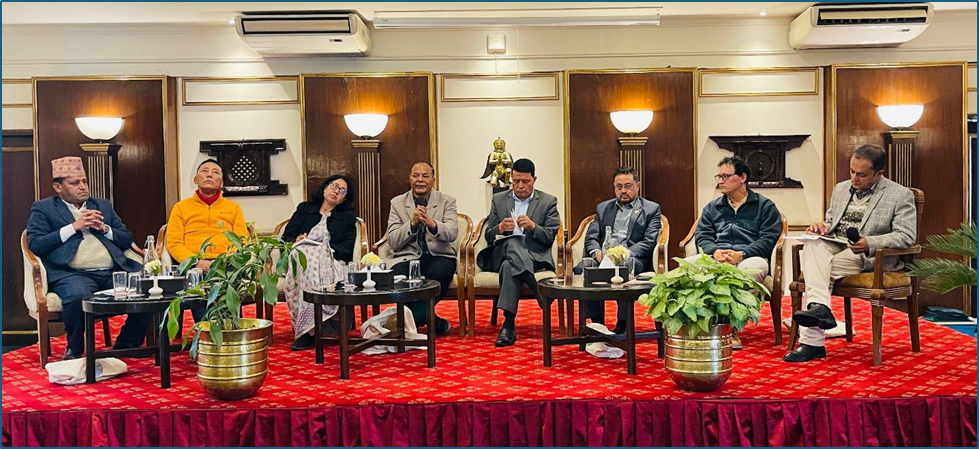
Kathmandu, November 28. The indispensable role of civil society in executing the complex tasks of post-disaster reconstruction and rehabilitation was underscored at the ‘National Development Dialogue 2026,’ organised by the NGO Federation of Nepal (NFN) in collaboration with Wildlife Conservation Nepal (WCN), on Saturday in Kathmandu.
Participants emphasised that civil society and non-governmental organisations serve as effective actors in the immediate rescue of affected communities, relief distribution, and subsequent reconstruction and rehabilitation efforts, and they urged the government to pursue these undertakings in partnership with civil society.
The opening session also featured the launch of NFN’s Civic Space Bulletin that showcases NFN’s “constructive engagement” (policy dialogues, budget recommendations), among other things.
The dialogue brought together CSO representatives alongside development partners, climate experts, donor agencies, and other important stakeholders. Dr Devendra Gauchan, a member of the National Planning Commission, asserted that the government alone cannot surmount the aftermath of the major disaster in the Rasuwa–Bhote Koshi region without the effective and active participation of civil society and NGOs.
“The government currently requires strong support from NGOs for climate action, green recovery, and green rebuilding,” he remarked. Dr Gauchan further observed that, despite the existence of an early warning system in the Rasuwa–Bhote Koshi area, some community members displayed a concerning lack of awareness, remaining on a bridge to record videos or continuing to work in their fields while the flood was occurring.
He stressed that NGOs could play a crucial role in the future by engaging directly with communities to raise awareness of climate change and disaster preparedness.
Dr Dharma Raj Upreti, Chief Executive of the National Disaster Risk Reduction and Management Authority (NDRRMA), stated that the government intends to expand the role of NGOs in post-disaster reconstruction and rehabilitation. “Governments at all three levels require the support of non-governmental organisations and civil society,” he remarked.
Furthermore, the government has opened its doors for donor agencies and development partners to collaborate in these efforts.
Climate expert Dr Samjhana Bista noted that as climate-related risks intensify, the scope for NGO and civil society involvement in fostering community resilience has expanded significantly.
She highlighted that NGOs have served as a strong, steadfast, and reliable pillar for the government, both before and after natural disasters.
Arjun Bhattarai, President of the NGO Federation, shared that Nepal, a nation highly vulnerable to climate change, has initiated a dialogue aimed at fostering collaboration and coordination with CSOs and NGOs in neighbouring China and India.
He mentioned that, on behalf of civil society, NFN has strongly advocated for “climate justice” at the UN Climate Change Conference (COP31), and that Nepal has begun facilitating intergenerational dialogues domestically while engaging in discussions with neighbouring countries to promote regional “green solidarity.”
Murari Prasad Kharel, Secretary of the National Human Rights Commission, pointed out that indigenous communities, particularly vulnerable to climate change, often face the deprivation of their fundamental rights.
He emphasised that civil society and NGOs have a significant role to play in supporting the government to ensure climate justice, and that Nepal and the global community should draw lessons regarding climate change damage from the natural disaster that struck the Bhote Koshi area in Rasuwa on August 26.
Similarly, former Foreign Minister Dr Bimala Rai Paudyal, former National Planning Commission member Min Bahadur Shahi, wildlife expert Dr Ghanshyam Gurung, and climate finance expert Raju Pandit Chhetri addressed the government’s priorities for resilient reconstruction and climate finance.
The event featured discussions and debates on how and in what ways the government can be supported in the rehabilitation and reconstruction of the Bhote Koshi flood-affected areas, with the conclusions drawn to be submitted to the government.
The Development Dialogue also featured the official launch of the Green Alliance Nepal (GAN) to Advance Collective Action for a Greener and More Resilient Nepal.
GAN brings together nine founding organisations to strengthen civil society collaboration, promote circular economy principles, and advance inclusive and sustainable green development in Nepal, led by WCN.
Founding members also shared their commitments and perspectives on mobilising INGO partnerships, strengthening local civil society action, engaging sectoral federations, and positioning non-profit organisations as drivers of green transformation.
GAN highlights the importance of collective action, cross-sectoral partnerships, and meaningful civil society engagement in Nepal’s green transition.
The official GAN website was jointly launched by representatives of the Association of International NGOs in Nepal (AIN), NFN, and Ms Rosalba Tuseo, EU Representative.
The session concluded with the felicitation of GAN members and congratulatory remarks from distinguished representatives of Good Neighbours International, WWF Nepal, the European Union, and NFN, who recognised the importance of the Alliance and extended their best wishes for its successful establishment and future contributions.
The launch of GAN marks an important milestone in fostering a united civil society voice and collaborative action towards a greener, more circular, climate-resilient and sustainable Nepal. RSS



Comments