


Foreign Affairs Minister Khanal calls for Nepal-China strategic partnership on cross-border early warning systems and climate security
Kathmandu: Foreign Minister Shishir Khanal has said the Himalayas should be viewed as a common ecological heritage of Nepal and China.
Addressing the session on ‘Nepal-China Relations: Expanded Dimensions of Cooperation’ under the third Kastamandap Dialogue in Kathmandu, Foreign Affairs Minister Khanal said the Himalayan region should be treated as an area of shared ecological destiny rather than merely a political border.
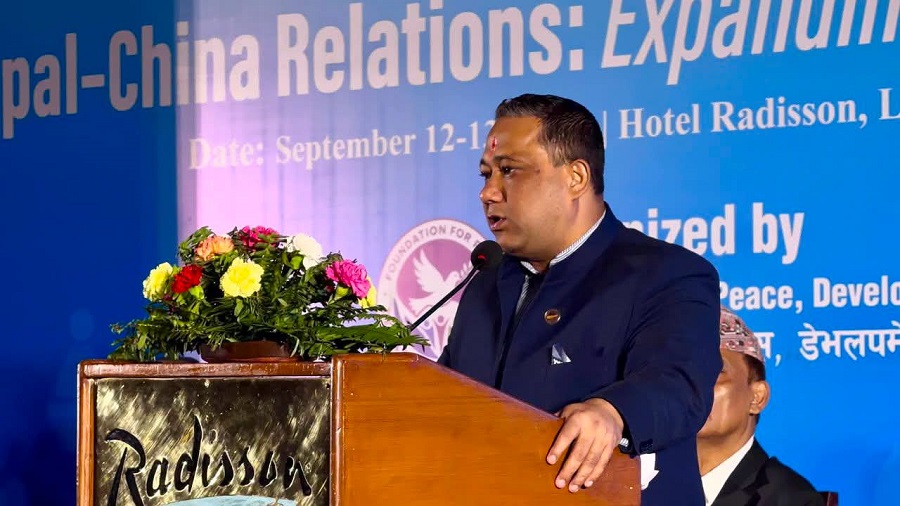
He said Nepal-China cooperation should focus on environmental resilience and climate security as climate-related risks in the Himalayas continue to increase.
Minister Khanal stressed the need for real-time satellite data sharing, joint weather forecasting and cross-border early warning systems to reduce the impact of disasters such as glacial lake outburst floods, landslides and extreme weather.
He said Nepal-China relations should move beyond traditional border management and advance as a strategic partnership covering climate security, technology, trade and infrastructure.
The Foreign Affairs Minister also expressed gratitude to China for its emergency and technical assistance, as well as hydrological coordination, during rescue efforts following the devastating Bhotekoshi floods.
He said Nepal remains firmly committed to the One-China policy and will not allow its territory to be used against neighbouring countries.
Foreign Affaris Minister Khanal said Nepal’s foreign policy is guided by the philosophy of the Middle Way, and that the country seeks to develop as an active and sovereign bridge between the two major economic powers.
He also said the government has prioritised good governance, social justice and economic prosperity, and that foreign policy should support the country’s economic development.
Foreign Affairs Minister Khanal highlighted the concept of ‘Thick Connectivity and Thin Borders’ under Nepal’s economic diplomacy. He stressed the need to improve infrastructure and disaster resilience at northern border points to advance the Trans-Himalayan Multidimensional Connectivity Network.



Comments