


Discussions ongoing on reports in NC’s Special General Convention
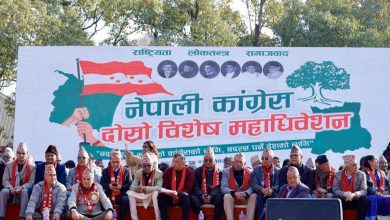
Kathmandu: The closed session of the Special General Convention of the Nepali Congress (NC) is extended until today.
The two-day-long Special General Convention, which commenced at Bhrikutimandap on Sunday, initiated by the party’s General Secretary duo, Gagan Thapa and Bishwa Prakash Sharma, was expected to conclude on Monday.
The convention was extended until today as the discussions continued on the reports presented by general secretaries Thapa and Sharma.
According to the Coordinator of Special General Convention Management Committee, Manoj Mani Acharya, the closed session will resume after a while. He also said that the registration of the Special General Convention representatives will continue even today.
After the policy-level decisions on the reports presented by General Secretary duo Thapa and Sharma, the election processes will also be advanced, it is said.
Nine separate groups were formed in the closed session, including seven based on the seven provinces, and two based on the valley and the sister organisations, well-wisher and public liaison committees.
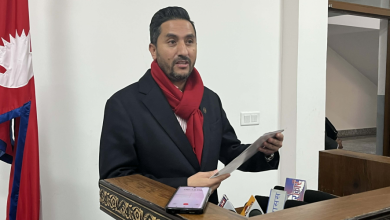
On Monday, General Secretary Thapa presented his political proposal on contemporary issues, outlining a vision to transform the party into a dynamic and advanced democratic force.
Through the proposal, Thapa assured that the Special General Convention would guide the party towards becoming an organization with clear guidelines and effective management, progressing toward a promising future.
“We will transform the Nepali Congress into a party with the revolutionary spirit of 2006 BS, the progressive and inclusive vision of 2015 BS, the popular mandate of 2048 BS, and the widely accepted leadership of 2062-63 BS,” Thapa announced.
The proposal includes a 17-point special resolution aimed at preparing the party for an integrated campaign to build a prosperous nation with renewed energy, enthusiasm, unity and transformation.
It pledges to curb corruption and ensure financial discipline and good governance through the formulation and enforcement of effective laws, enhancement of institutional and agency efficiency, simplification and strengthening of procedures, and the establishment of a transparent, efficient and accountable administrative system.

Comments