


Minister Dr Timilsina raises issues of Nepal’s disaster, digital divide at World Telecommunication Forum
Kathmandu: Minister for Information and Communications, Dr Bikram Timilsina, has underlined the need for expanding international cooperation to protect telecommunication infrastructures from climate-induced disasters, reduce the digital divide and ensure equal access to emerging technologies, including artificial intelligence (AI).

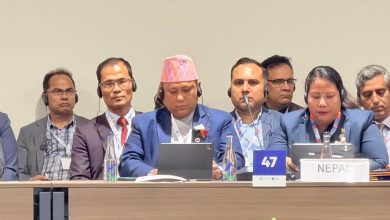
Presenting Nepal’s national policy at the World Telecommunication Policy Forum of the International Telecommunication Union (ITU) in Doha, Qatar, Minister Dr Timilsina said the technical assistance, technology transfer and concessional financial assistance are essential to uplift the developing and least developed countries in the process of digital transformation.
Although global digital transformation has created new opportunities, the developing countries are at risk of falling behind due to unequal access to computing capacity, skilled manpower, investment and technology.
The Minister said that, in addition to the inequality in digital access, a new sort of digital divide was emerging based on access to emerging technologies such as AI and 5G. He underlined the urgency of international cooperation for the equal benefits of digital transformation among all countries and communities.
Nepal has made significant progress in expanding digital connectivity, he shared with the global community, adding that access to mobile voice services had reached more than 100 percent of the population and access to fibre broadband is 53.4 percent.
The telecommunication infrastructure is being expanded in the unserved and remote areas through the Rural Telecommunications Development Fund, and more than 20,000 kilometres of optical fibre were expanded under the National Information Highway.
The Minister also shared other programmes and progress on digital connectivity and expansion in Nepal.
Although Nepal has made progress in expanding digital infrastructure, it remains challenging to provide equal digital access to all citizens due to geographical remoteness, scattered settlements, limited resources and high infrastructure costs, according to him. He drew the attention of the international community to the serious risks posed to telecommunications infrastructure and communication services by climate change-induced disasters in Nepal. The flash floods occurred in August damaged Nepal’s main telecommunications fibre network and affected 198 mobile base transceiver stations (BTS), the Minister informed.
“The disruption of communication links created challenges in rescue, relief and exchange of emergency information. However, more than 90 percent of the affected communication services were restored within three days. It reflects the need for disaster-resistant telecommunications infrastructure and reliable emergency communication systems has become more pronounced,” the Minister stressed.
The Minister also shed light on the challenges of increasing cyber fraud and cybersecurity, along with the expansion of digital services, lack of necessary skills in the use of digital technology, and the urgency to make telecommunications infrastructure environmentally friendly.
Nepal is prioritising affordable and reliable digital connectivity, digital infrastructure, cyber security, digital skill development, and responsible use of emerging technologies, he mentioned in the address.
Dr Timilsina urged ITU and member states to provide special support to expand digital access in rural areas, build disaster-resistant communication infrastructure, develop emergency communication systems, and ensure equal access to emerging technologies. It is essential to meaningfully include the needs and voices of least developed and developing countries while determining ITU’s strategic and financial priorities for 2028-2031, he suggested.
The Minister assured Nepal’s readiness to collaborate with the international community to achieve the common goal of digital transformation.
RSS



Comments