


Ghandruk village: An unavoidable touristy sight
Gandaki: A village with dense traditional housing, the snow-clad peaks right before the eyes and the bright morning with pleasant punctuation of birds chirping. It is a recent morning ambience on a hiking trail around Ghandruk, which passes through forests, ridges, and the way up the hills and down the hills.
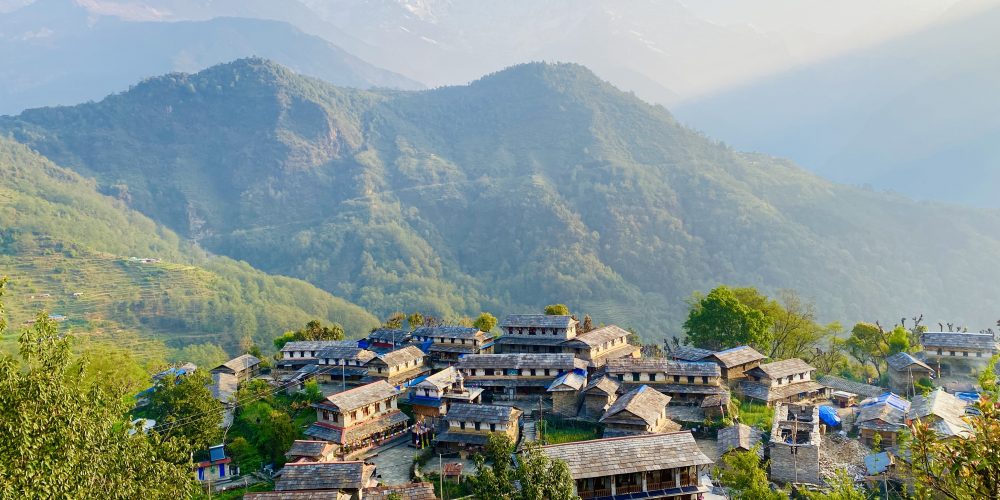
The touristy village of Ghandruk is indeed a mesmerising sight for everyone treading the circular trail for two years. The circular trail provides an opportunity for the visitors to relish the natural beauty of Ghandruk and the vicinity. The village is located at ward nos 10 and 11 of Annapurna Rural Municipality of Kaski district.
The trekking route emanating from Ghandruk Bus Park stretches to various places like Kotgaon, Balache garden, Deurali, Navri, Theb Meshra Baraha Temple, Kochama Pwa, Nego, tea estate, Dandagaon, before concluding at the same Bus Park. Chairman of the Ghandruk Tourism Management Committee, Bikram Gurung, informed that 60 percent of the works under the circular trail were over.
The construction of the trail had begun three years ago at the initiative of the Committee.
“This year, additional works are underway by securing a budget of Rs 2 million from Nepal Tourism Board,” he said, adding, “All three governments have extended support to this bid. Even the local donors have supported the construction of the trail.”
As part of the trekking route, infrastructural activities are going on, which, he argued, would help in enriching Ghandruk as the unavoidable tourist destination of Gandaki Province. It would further help in extending tourists’ stay in the Ghandruk village and neighbourhood.
The trekking route begins from a forest above the Ghandruk village. Currently, parks, resting places and gazebos are being built along the trail. A tourism entrepreneur from Ghandruk, Amrit Lama Gurung, said that the circular trail is a salubrious sight for tourists.
The short-distance hiking acts as a refresher to the tourists, especially those running away from the maddening crowds of cities, he added.
“Tourists spending nights in Ghandruk can also tour the trekking route the next morning while relishing the sunrise. You can enjoy the scenic view of the valley during the walk up the hill from Ghandruk village. Mesmerising nature energises trekkers,” he explained.
The Mesram Barah Temple along the trekking route bears significance to the Gurung community. It further helps in drawing religious enthusiasts. The Committee has so far spent Rs 5.3 million on constructing the trekking route.
Importantly, the trekking route is being built in an original style, using locally available construction materials. There will be two parks- at Balache and at Buddha- along the path.
Chief of the Area Conservation Office under the Annapurna Conservation Area Project (ACAP), Bhim Prasad Upadhyay, hoped the trekking route would certainly be a new attraction to Ghandruk’s tourism.
ACAP has been extending support in areas including the development of tourist infrastructures and the empowerment of local people in Ghandruk. Upadhyay added that Indian tourists were in large numbers among those taking a tour to the Annapurna region via Ghandruk.
According to him, as many as 856 foreign tourists arrived in Ghandruk on a single day in the current season.
“Lately, the number of Indian tourists has increased significantly. Even the domestic tourists are on the rise,” he informed. He credits the expansion of the road network and access behind the increasing number of tourists.
Hiking has been a new trend, so attractive destinations and better infrastructure evidently attract tourists and contribute to the thriving tourism business in Ghandruk. The tourism began here in the 1930s, 50 years ago.
However, a section is showing concern whether the village and the surrounding area would maintain its originality in the wake of the hustle and bustle of tourists. The locals are for not changing the culture and nature, while expanding tourism activities.
The art and culture of the Gurung community should be kept intact in the face of modernity, according to them. The Tourism Management Committee here informed that there are 80 hotels, including resorts.
The number of homestays stands at 35. The hotel and homestay business are major sources of income for the locals. Hundreds of people have got jobs in the tourism sector here.
Nearly 2000 to 3,000 tourists visit Ghandruk every day in the season. It takes two hours’ bus ride to reach Ghandruk from Pokhara City.
RSS

Comments